What's up with the word "egregious"?
According to Google's dictionary (and MacOS/iOS dictionary), egregious has the following definitions:
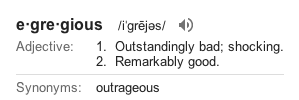
I've seen words with multiple definitions, but not ones that are exact contradictions. Some references state that "remarkably good" is archaic - is it possible that the meaning of this word has changed over time to be the exact opposite of what it once meant?
4 Answers
I found the following reference¹:
Bill Bryson is a more popular writer on the subject of language. Discussing changes in word meanings, Bryson writes:
Surprisingly often the meaning becomes its opposite or something very like it. Counterfeit once meant a legitimate copy. Brave once implied cowardice — as indeed bravado still does. (Both come from the same source as depraved). Crafty, now a disparaging term, originally was a word of praise, while enthusiasm, which is now a word of praise, was once a term of mild abuse. Zeal has lost its original pejorative sense, but zealot curiously has not. Garble once meant to sort out, not to mix up. A harlot was once a boy, and a girl in Chaucer's day was any young person, whether male or female. Manufacture, from the Latin root for hand, once signified something made by hand; it now means virtually the opposite. Politician was originally a sinister word (perhaps, on second thoughts, it still is), while obsequious and notorious simply meant flexible and famous. Simeon Potter notes that when James II first saw St. Paul's Cathedral he called it amusing, awful, and artificial, and meant that it was pleasing to look at, deserving of awe, and full of skilful artifice.
This drift of meaning, technically called catachresis, is as widespread as it is curious. Egregious once meant eminent or admirable. In the sixteenth century, for no reason we know of, it began to take on the opposite sense of badness and unworthiness (it is in this sense that Shakespeare employs it in Cymbeline) and has retained that sense since. Now, however, it seems that people are increasingly using it in the sense not of bad or shocking, but of simply being pointless and unconstructive.
According to Mario Pei, more than half of all words adopted into English from Latin now have meanings quite different from the original ones. A word that shows just how wide-ranging these changes can be is nice, which is first recorded in 1290 with the meaning of stupid and foolish. Seventy-five years later Chaucer was using it to mean lascivious and wanton. Then at various times over the next 400 years it came to mean extravagant, elegant, strange, slothful, unmanly,luxurious, modest, slight, precise, thin, shy, discriminating, dainty, and – by 1769 – pleasant and agreeable. The meaning shifted so frequently and radically that it is now often impossible to tell in what sense it was intended, as when Jane Austen wrote to a friend, ‘You scold me so much in a nice long letter ... which I have received from you.’
¹ Bill Bryson, Mother Tongue [London: Penguin, 1990], pp. 71-72
The etymology of egregious is simple: e- from ex- meaning "out of," plus greg- or grex- meaning "herd." (The root greg- or grex- also developed into the English word gregarious). Egregious is applied to a number of things that stand out from the herd: it is used synonymously with extreme, extraordinary, and notorious. More rarely, it has been used as an etymologically-correct antonym to gregarious, meaning "asocial."
Back in the 16th century, egregious meant "remarkable for good quality; striking; distinguished." That sense disappeared, but not before egregious developed the (still current) sense "notorious; conspicuous for bad quality or taste."
Courtesy: word.com (M-W online newsletter)
In fact, there is a term for words that have meanings that are opposites of one another: contronym or auto-antonym. That page gives a number of examples, although it doesn't include "egregious" (it's not a complete list).
When examining the evolution of a word's meaning, it's essential to consider the historical context in which it was used. In the case of "egregious," its original meaning was indeed positive, but over time, it took on a more negative connotation. To understand this shift, let's look at the word's roots. The prefix "e-" comes from the Latin "ex-" meaning "out of," and "greg-" or "grex-" meaning "herd." This suggests that "egregious" was initially used to describe something that stood out from the crowd or was exceptional in a positive sense. However, as language and societal norms evolve, words can take on new meanings or connotations. In the 16th century, the sense of "remarkable for good quality; striking; distinguished" disappeared, and "egregious" developed its current meaning of "notorious; conspicuous for bad quality or taste." This change may be attributed to the growing emphasis on individuality and the rise of negative social commentary. It's also worth noting that the development of new words and their meanings can be influenced by cultural and historical factors. For instance, the rise of satire and social criticism in the 17th and 18th centuries may have contributed to the shift in "egregious" from a positive to a negative connotation. The concept of "egregious" as a word with multiple meanings that are opposites of one another – a contronym or auto-antonym – is interesting, but it's essential to consider the nuances of language and the complexities of meaning evolution. In the case of "egregious," the change in meaning is not simply a reversal, but rather a shift in the way the word is used to describe something that was once seen as exceptional or remarkable. Ultimately, the study of language and its evolution can provide valuable insights into the ways in which words and meanings change over time, reflecting the complex and dynamic nature of human communication.
In-depth guide available
What's up with the word "egregious" →Have a similar question?
Ask the community →