Our teacher is encouraging us to use cracked software
I'm taking a course named Numerical and Computational Methods Based on Mathematica (Or in Chinese: "基于Mathematica的数值计算方法"), but Wolfram Mathematica is a bit expensive for me to afford. On the first lesson of this course, the teacher told us how to crack this software, and asked us to have Mathematica 11.0 installed on our computers by this Wednesday. However, I just don't want to use cracked softwares.
While it is true that software cracking is inappropriate and even illegal, almost everyone around me uses cracked softwares(such as PS, AE...). As far as I know, nobody in the rest of our class refuse to crack and install the software.
So what should I do? Having a talk with my teacher or simply quitting this course?
Follow-up:
Finally, I've decided to quit this course, because I think I can gain the same knowledge by learning Mathics, a free software recommended by some answers below.
Thank you for all the awesome answers!
Follow-up II:
I feel obliged to mention that now everyone can download the Free Wolfram Engine for Developers. From my understanding, the Wolfram Engine implements the Wolfram Language and is the very kernel of Mathematica, so this is basically a free full version of Mathematica, just without the notebook interface.
3 Answers
My advice is to just use the pirated software and not rock the boat, just like Drunken Code Monkey, for example, mentioned.
This issue isn't something that you're likely to solve yourself. Instead, you're most likely going to spend large amount of time and energy on nothing and produce no results. The fact that your teacher just expects you to get cracked Mathematica is a proof enough that it's something completely normal and accepted by your society. Now, I'm not going to preach to you about your own personal ethics or if you should feel bad about the situation or not. Others have given more than enough options.
Instead, I'm going to talk a bit about how things like this are resolved in other places. I myself am from Serbia, a country that has been recently opening itself to the idea of actually giving money for software, so I've seen a bit of how negotiations between foreign software companies and locals work.
Basically, on one hand, the "manufacturer" of the software is suffering what some might consider a loss, since you, your fellow students and the institution aren't paying for licenses.
On the other hand, keep in mind that they also have a direct benefit from you: You're increasing the user-base of their software.
Mathematica isn't new and it's not going to disappear because you aren't paying for it. Instead, it has a chance to thrive: You're using Mathematica and not competitors. That means that you'll be most likely comfortable using Mathematica and not some other tool that take getting used to. At your future employer's place, you'll probably feel more comfortable again using Mathematica than alternatives.
This means that your area is a very interesting potential market for Wolfram. Sure, you're not paying now, but directly, that fact doesn't cost Wolfram anything. Keep in mind that software prices are not calculated by how much a license costs (because it costs pretty much nothing and the trend is to reduce physical costs as much as possible), instead they're calculated by how much potential customers want to pay for it. In some cases, the "normal" prices might be very far away from what you can normally afford.
The bottom line for software companies is that they want money, specifically, more money than they invested into the creation of software. Their user-base is a potential source of money. If the users are paying, that's great, if they're the non-paying type of users, you want to convert them eventually into paying type of users using various methods (student licenses come to mind, for example). If you spend resources to convert the non-paying users into non-users, you just wasted your own money for no profit at all.
The result is that, if Wolfram has a sufficiently large user base in China, and at the same time, the political situation in China changes to a point where Wolfram can start negotiations on licensing, the educational institutions could end up getting real licenses for their computers.
These licenses could be either payed individually, or through an agreement with your government for a form of collective licensing. They might even be "donated" as a show of "good will". There might be an agreement for a combination of donated and purchased licenses or a certain ratio of tolerated "non-purchased" and purchased licenses, eg. you'll buy 5 and we'll let you use up to 15 licenses or similar. There might be an agreement that a company could be allowed (or maybe even given government backing) to persecute or at least aggressively negotiate with commercial pirates in return for giving licenses to government and educational institutions. Sometimes, it's much easier to put pressure on a large for-profit company that has money to pay licenses than to put pressure on a smaller institution that in the end won't even be able to pay anything.
Possibilities are great, depending on what the company and relevant institutions manage to officially or unofficially negotiate. Do note that, if the political climate is ripe-enough, such negotiations can be very profitable for the company. After all, some money is much better than no money, as long as it doesn't take too much effort to obtain it.
While it is true that software cracking is inappropriate and even illegal, almost everyone around me uses cracked software
That is really bad and I know it happens also in my country (Italy). However, I think there is a false dilemma in your question:
So what should I do? Having a talk with my teacher or simply quitting this course?
There are not the only options you have. There is a third one, which is using Mathematica (or the Wolfram Language) legally for free. Although I am a very happy SageMath user, I've been curious to find out what the options for Mathematica are. In the past it was impossible: you either paid for Mathematica or illegally cracked it, but nowadays there are more ways.
I will describe three of them, but bear in mind that some might be slow or have some limitations. Nevertheless, given that your class is called Numerical and Computational Methods Based on Mathematica I think these defects won't impact your learning.
Use the Wolfram Programming Cloud (online only)
Mathematica is basically a nice GUI for the Wolfram Language. Since January 2016, the Wolfram Cloud has been launched with two free options:
- Wolfram Development Platform
- Wolfram Programming Lab
You can launch the website at wolframcloud.com and you will need a free account which will give you limited deployment capabilities. But these capabilities are only needed if you want to deploy some code as a cloud API, not to perform computations.
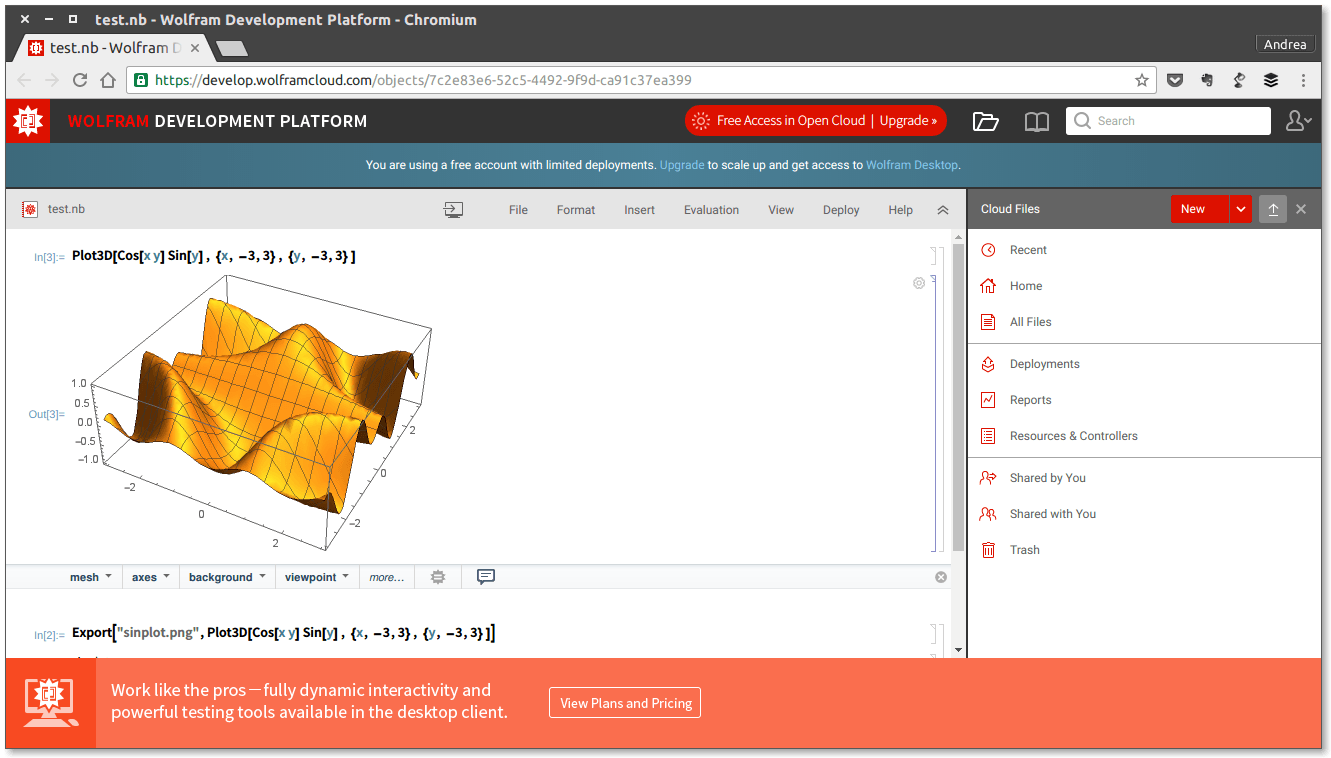
Here I am using the Wolfram Cloud to plot a function:
Use Mathematica on the Raspberry Pi (slow)
If you happen to own a Raspberry Pi, you actually have the software as part of the Raspbian operating system. On my Linux computer, I can connect to the Raspberry Pi via SSH using the -X switch for GUI applications:
ssh -X pi@raspberrypi.local
Then, I can run Mathematica:
mathematica
Keep in mind that this will be slow, because while you are using the GUI via your computer, the computations are performed on the Raspberry Pi.
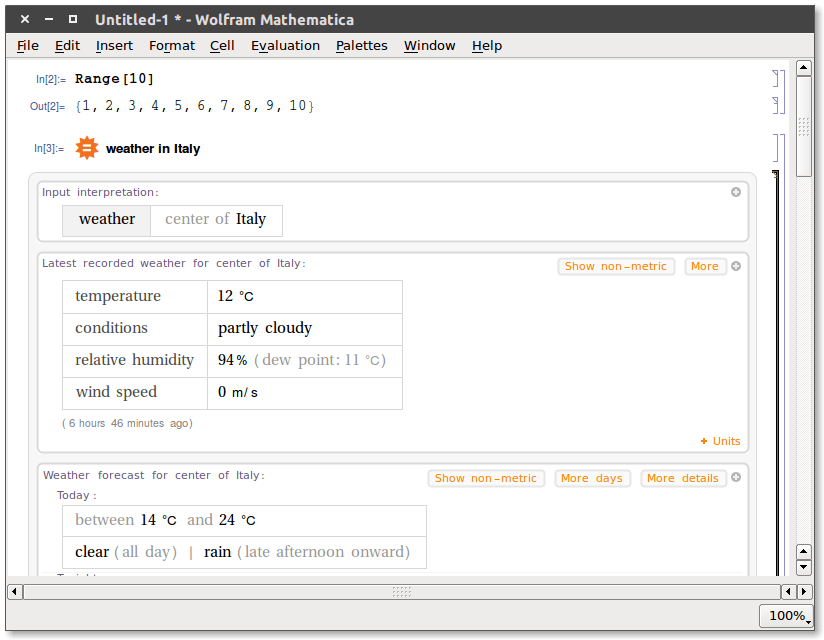
Here's a screenshot of a simple command and a Wolfram Alpha query, using the free Raspberry Pi version:
Emulate a Raspberry Pi (super slow!)
If you need to satisfy these two constraints:
- no Raspberry Pi available
- offline access needed
Then you can emulate an ARM architecture and install Raspbian on it. It is going to be very slow but it can be done. UnixMen.com has a nice tutorial about a recent version of Raspbian (from 2015) that should be enough to get you started.
Talk to your teacher
Finally, I think it's good to underline again the fact that you should really raise your concerns to your teacher and (at the very least) mention that you have to use one of these workarounds because they are not providing you with the needed tools.
Something similar happened to me in a few instances:
In high school a teacher wanted to give me a pirated copy of LabView. I refused, telling him "I do not use pirated software. Besides, this is a Windows program so I cannot run it".
Of course this was pretty easy because it was high school, so there were no classes to choose or to drop and I had to attend the lectures. Moreover it was just a suggestion to "study better" and it was not really required that students used the software at home.
During my MSc, we were required to use Matlab for assignments but the university won't provide licenses for personal machines, only for lab machines. I was living a bit far from the university, thus I discussed about this with the teacher and got to use Octave instead.
I made sure my code was Matlab compatible except for once when I used a shorthand operator not available in Matlab (it was
a += b). Since I spoke with my professor beforehand, he was keen enough to correct the typo for me and grade the assignment. Basically, talking can help you solve a lot of things.
One thing you should absolutely avoid doing is cracking the software yourself. That opens you personally to a whole lot of legal issues (IANAL, but this is kind of obvious). If your computer is really yours, it should be possible to complete the course without one. Not as convenient, of course (e.g. you may have to stay after classes to use the classroom PCs), but still.
If your computer is a machine you were given by the institution to be used during the course, it should be provided with the software you need. Go to the IT department, tell them you are required to have Mathematica 11 for your course and ask them to install it. When confronted with the need of cracking the software themselves, IT guys may end up finding a license for you. At the very least, if they crack the software for you, you can still consider yourself a bona fide user in case your institution gets busted.
Have a similar question?
Ask the community →